
The Definitive Guide to Above-Ground Pool
Cleaning and Maintenance in Riyadh
Engineering Clarity: A step-by-step, highly readable breakdown of professional pool remediation and scientific water balancing.
The intersection of residential leisure and extreme climatic conditions in the Kingdom of Saudi Arabia requires a highly engineered approach to swimming pool maintenance. In the metropolitan expanse of Riyadh, where peak summer temperatures frequently exceed fifty degrees Celsius and regional dust storms introduce constant airborne debris, preserving a pool demands rigorous chemical balancing, advanced filtration, and strategic maintenance.
Concurrently, the rise of residential pools—specifically modular, vinyl-lined frame structures manufactured by brands such as Intex or Bestway—has introduced unique maintenance needs. While accessible and cost-effective, their scaled-down filtration hardware requires highly optimized protocols to keep the water crystal clear.
By analyzing active field operations—specifically a recent intervention by a professional team deployed to remediate a severely cloudy Intex above-ground pool in Riyadh—this guide provides a step-by-step, highly readable breakdown of professional pool remediation.
Visual Diagnostics and Site Assessment
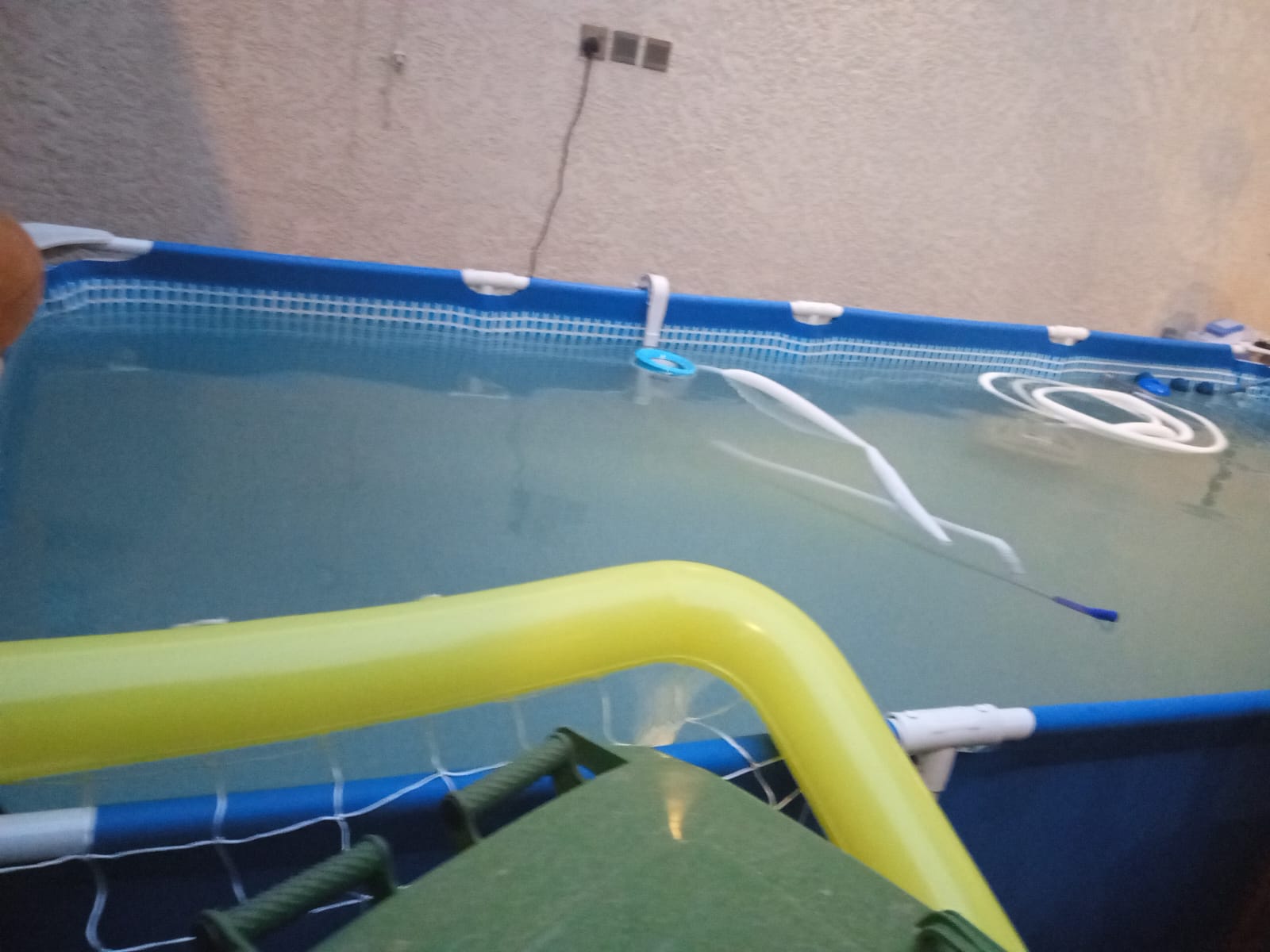
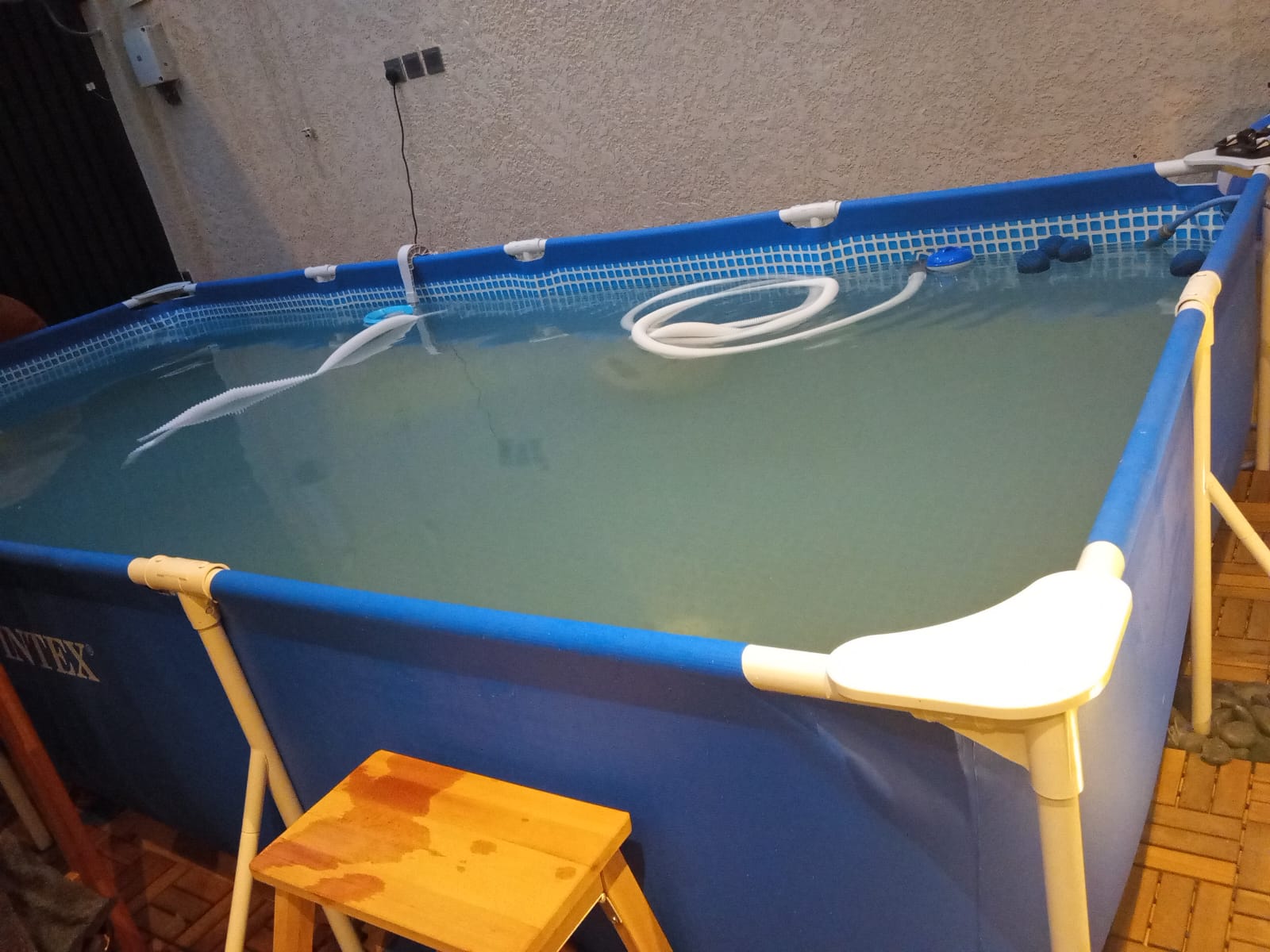
The initial phase of any professional aquatic remediation involves a comprehensive site assessment. Based on the visual data captured by the field team, the subject is a large, rectangular above-ground pool, consistent with an Intex or Bestway tubular steel frame model.
The primary diagnostic indicator is the severe turbidity of the water. The images reveal a milky, pale-green hue that completely obscures the vinyl floor. This lack of transparency points to three immediate issues:
- A high concentration of suspended particulate matter.
- An early-stage algae bloom.
- A fundamental breakdown in the chemical sanitization equilibrium.
Above-ground pools of this classification present distinct challenges. Their circulation systems frequently utilize lower-horsepower pumps and smaller cartridge filters, which can struggle to process the heavy environmental loads characteristic of the Riyadh climate.
In the arid Najd plateau, the primary external contaminant is the Shamal—the dominant wind that brings intense dust storms. These storms deposit massive volumes of microscopic silicates and phosphates directly into open swimming pools. Phosphates serve as the primary nutrient source for algae. When combined with high ambient temperatures, this creates the perfect biological incubator for rapid algae blooms.
Chemical Diagnostics: The Imperative of Water Balance
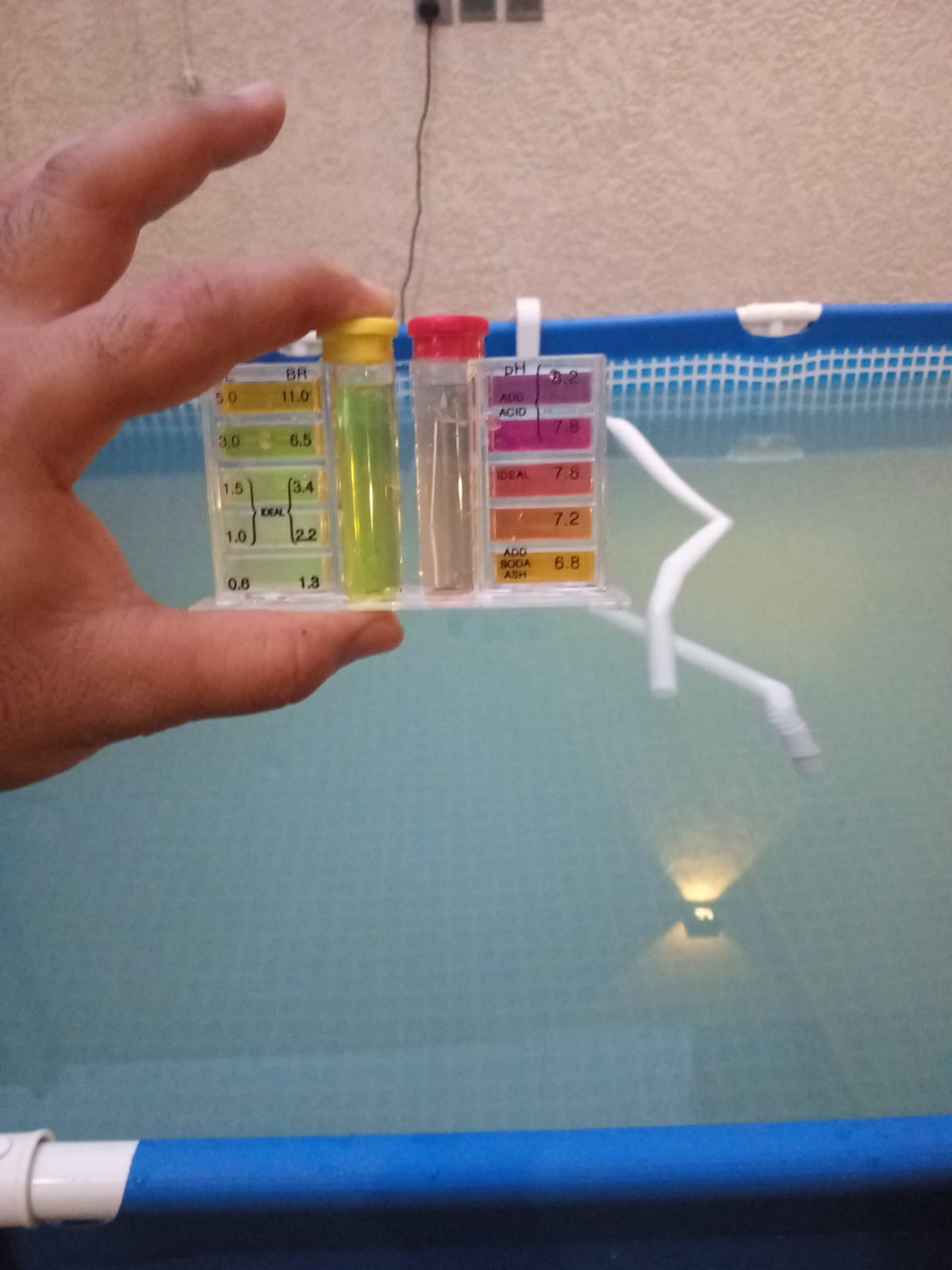
The cornerstone of aquatic remediation is precise chemical diagnostics. Relying on visual observation alone is insufficient; empirical data must dictate your next steps.
Image 3 provides clear visual documentation of a standard liquid-reagent test kit utilized on-site. This tool is vital for establishing baseline parameters before any corrective action is taken. An analysis of this test kit reveals exactly why the pool has turned green:
- High Total Chlorine (Left Chamber): The bright, fluorescent yellow-green coloration indicates a substantial presence of halogen sanitizer within the water.
- Highly Alkaline pH (Right Chamber): The deep magenta or bright red liquid unequivocally indicates a highly alkaline state, with the pH likely registering at 7.8, 8.2, or even higher.
The correlation between these two readings is the fundamental cause of the pool’s biological failure. The killing power of chlorine (hypochlorous acid) is intrinsically linked to the pH of the water. As the pH rises into the highly alkaline spectrum, the chlorine rapidly becomes a significantly weaker oxidizer.
The Threat of Total Dissolved Solids (TDS)
Beyond immediate pH issues, the extreme heat of Riyadh introduces a chronic, invisible threat: the rapid accumulation of Total Dissolved Solids (TDS).
The Evaporation Cycle: In Riyadh, hyper-evaporation acts as a relentless concentrating mechanism. As pure water evaporates, dissolved solids are left behind, leading to a rapid increase in the TDS count.
Chlorine Lock: When TDS exceeds optimal thresholds, the water experiences “chlorine lock.” Chlorine molecules bond with the excessive dissolved solids rather than oxidizing pathogens.
When TDS is too high, the only effective solution is partial water replacement and dilution.
Remediation Protocols: The Chemistry of Eradication
With the diagnostics established—high pH, high inactive chlorine, and active algae—the field team must execute a precise, sequenced protocol to transition the water from green to blue. Attempting to “shock” a pool with a high pH is an expensive waste of time.
Step 1: pH Suppression Technicians must first introduce an acid to forcefully lower the pH into the optimal range of 7.2 to 7.4. This specific range guarantees that the chlorine will be highly active, while remaining safe for the vinyl liner.
Step 2: Superchlorination (Shock) Once the pH is stabilized, the “shock” phase is initiated to achieve “breakpoint chlorination”—the threshold where chlorine completely destroys the molecular structure of the algae.
Step 3: Mechanical Agitation This chemical assault must be paired with aggressive brushing of the pool’s walls and floor. Brushing disrupts the algae’s biofilm, exposing it directly to the lethal chlorine.
Hydrodynamic Interventions: Manual Vacuuming
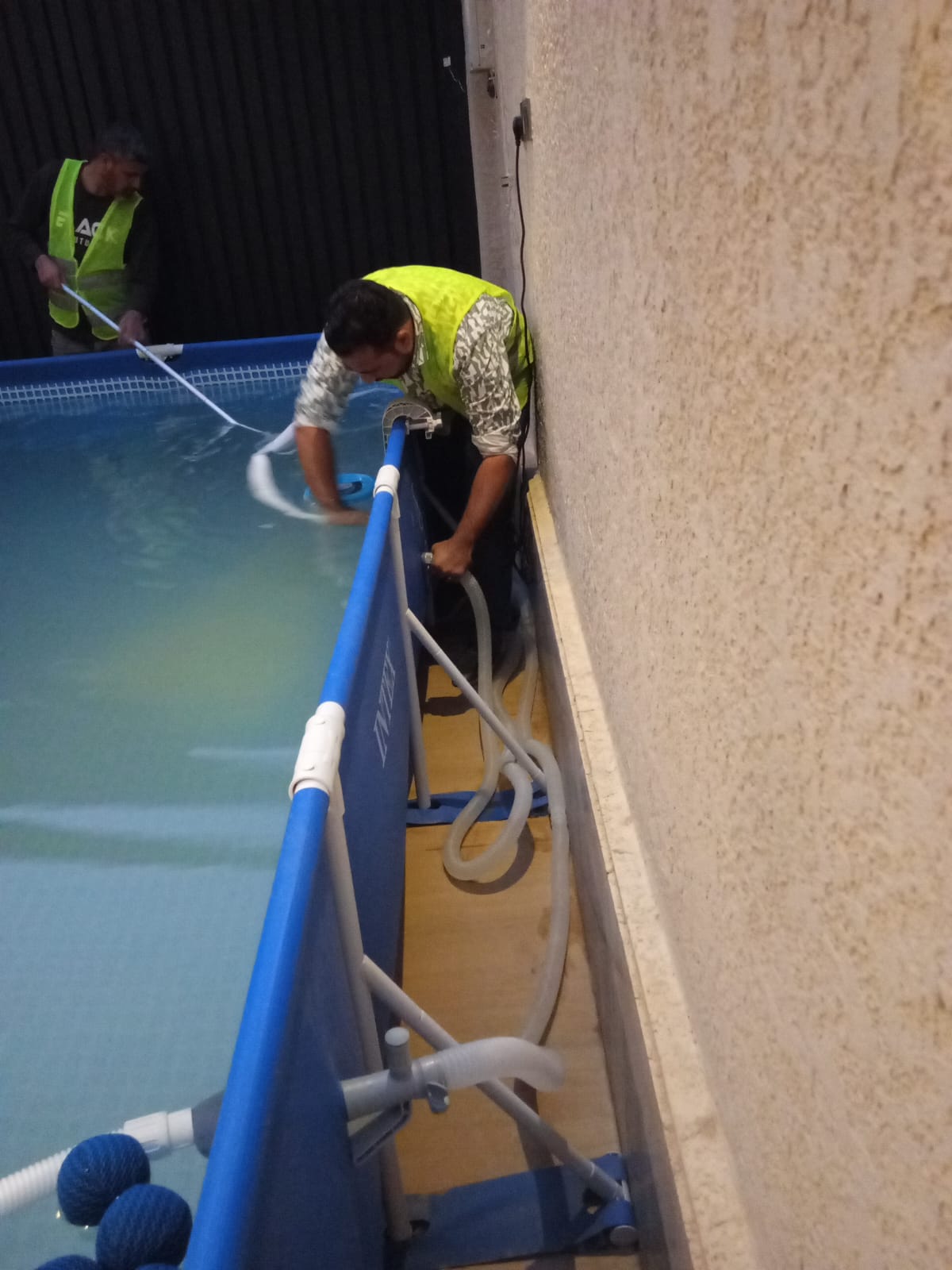
Chemical eradication leaves the pool filled with microscopic, deceased algal carcasses, which present as a cloudy suspension. To achieve crystalline clarity, this debris must be physically removed.
- Priming the Hose: The most critical step is submerging the vacuum hose entirely to expel all ambient air.
- Vacuuming to Waste: If the pool has an upgraded sand or media filter, the optimal strategy is to vacuum directly to the “Waste” setting.
- Methodical Cleaning: The technician must sweep the floor in overlapping grid patterns.
Advanced Filtration Mechanics: Polymer Filter Balls
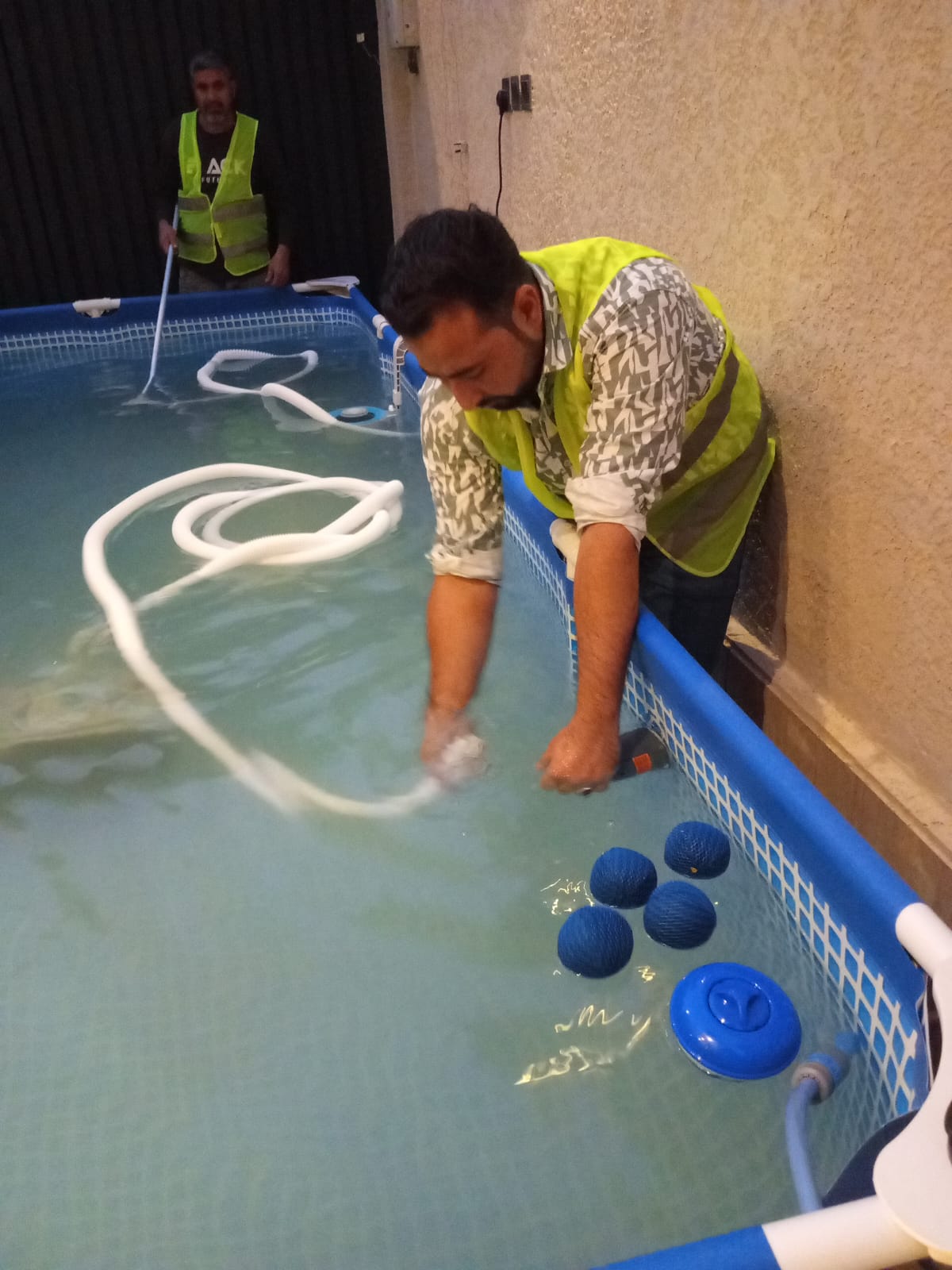
A fascinating detail captured in Image 5 is the presence of polymer pool filter balls, representing a massive advancement in aquatic filtration technology for the Middle East.
Historically, the standard for pool filtration in Riyadh has been silica sand. However, standard silica sand can generally only capture particles down to 20 to 40 microns. The ultrafine silicates frequently measure smaller than 20 microns.
Manufactured from high-grade, interwoven polyethylene fibers, polymer filter balls capture dramatically finer particulate matter—down to 3 to 5 microns. This capability is transformative for maintaining crystal-clear water.
Conclusion
The successful operation of a swimming pool maintenance enterprise in Riyadh requires absolute mastery over environmental engineering. The harsh realities of the Saudi climate demand technical interventions that far exceed standard global practices. From the sophisticated management of TDS to advanced polymer filtration media, the physical maintenance of these aquatic environments is a rigorous, unforgiving science.
Our Service
Secure Your Pool’s Health
Need professional assistance? Let Mehwar Al Madar apply Engineering Clarity to your above-ground pool maintenance.